As children our survival is dependent on the knowledge that we are loved. It is critical for growth and development, and without a base level of nurturing and attachment, we will die.
It would be detrimental for a child to realize that they are not loved during those fundamental years, therefore they must hold that belief above all else (despite often having evidence to the contrary); even if it means doing mental gymnastics in order to do so.
I’m not saying that somewhere deep down children don’t know the truth, or that they never internalize they’re unlovable. These messages do sneak in, but they’re most likely not conscious at such a young age.
This is why lying to ourselves or splitting off from our intuition can become a way of survival for so many, and last long into adulthood.
So, back to a child’s need to believe they are loved: If this is the foundation upon which all else is built, then it’s highly likely that they will develop a dysfunctional belief about what love is.
Put another way: once you’ve decided a caregiver’s behavior = love, then anything that follows becomes your definition of love.
Common descriptions of love used by adults in therapy include:
• Absence
• Control
• Confusion
• Pain
• Being trapped/suffocated
Hmmm. ..seems like the wires got crossed somewhere.
How does this show up in relationships?
If love = absence then you will most likely choose friendships and romantic relationships with people who are unavailable in some way. It could be that they’re already in a relationship, or that they’re geographically unavailable due to living far away, traveling frequently for work, etc. They may also be “absent” due to substance use or dependency.
If love = control then you may attract people that try to micromanage you, or have a vested interest in you feeling incompetent and/or dependent on them.
If love = confusion, you may find yourself surrounded by people with inconsistent or unpredictable behavior.
You get the idea.
Basically we seek what is familiar. If we’re used to feeling an emotion, then that may be our comfort zone- whether we consciously prefer it or not.
We usually don’t, because it’s most likely become our own unique brand of hell by that point.
There’s a million ways to say this next part, but I’m going to go with the most basic one for simplicity’s sake: repeating and recreating our childhood is our psyche’s way of trying to resolve it.
You could also say “like attracts like” and that if you’re carrying it in your energy field it will materialize in the external.
Both are true.
I really like the way Alice Miller describes it in her book The Drama of the Gifted Child: our adult relationships are often a “desperate attempt to re-write the childhood narrative.”
By this point you may be thinking “What hope do any of us have at forming healthy connections and experiencing ‘true love’?”
While it’s unreasonable to think we can solve the whole thing in a single blog entry, I have an idea that may be a profound epiphany for some, and a gentle nudge in the right direction for the rest.
Let’s just try this on and see how it feels:
THAT WASNT LOVE.
There. I said it. How did it land?
If your first response was “ouch,” then I agree. However, it’s more like the pain of ripping a bandaid off- a momentary sting, as opposed to low level discomfort for 40+ years.
I guarantee it hurts less than the battle wounds sustained by unconsciously recreating the experiences of the past over and over.
See, we aren’t children anymore. What would’ve been destabilizing back then is empowering now. When we bring our adult consciousness to the present moment, we have the power to liberate ourselves, and past/future generations simultaneously.
“The truth will set you free.”
John 8:32
I’m not saying there wasn’t love in there somewhere, but I personally am not interested in spending my whole life searching for what could really be a needle in a haystack (refer to previous blog on confusion).
I’d much rather spend my time around people that are sure how they feel about me, and aren’t afraid to let me know it.
Also a productive usage of time: doing personal work to learn what true love feel can feel like, and removing the barriers we have to receiving it.
So, to recap. ..
What is love?
Well, it’s what you were shown- until the moment you decide its not.
After that, it’s whatever you want it to be ❤
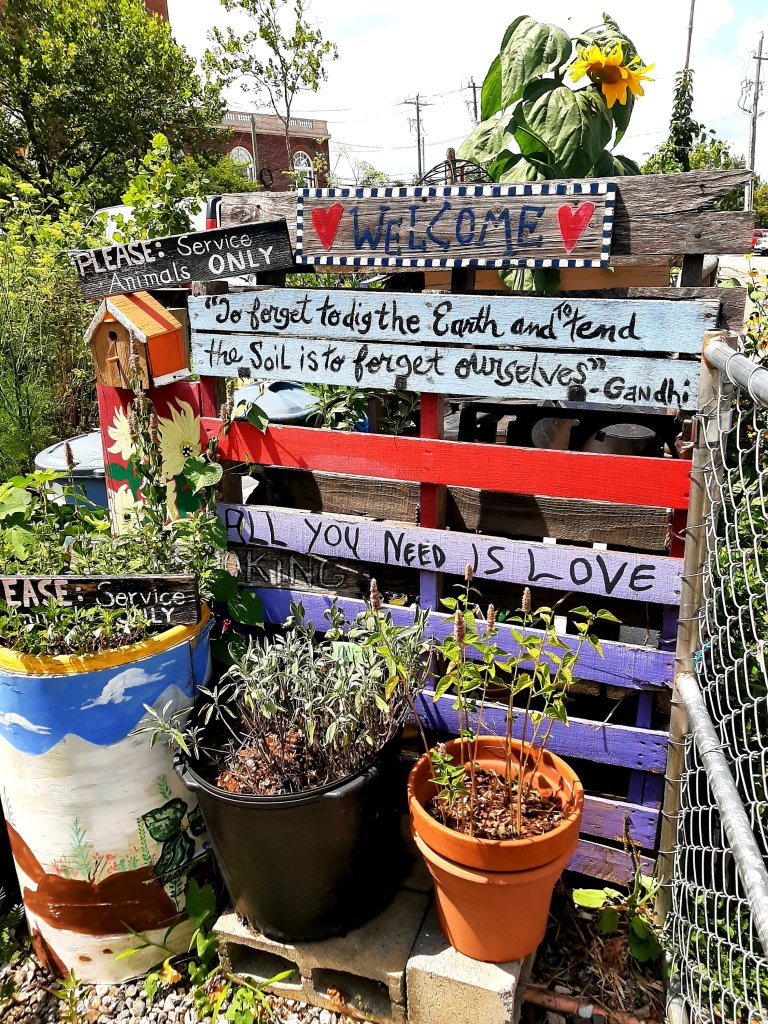
Photo: Downtown Asheville, NC August 2021
 Anatomy of an Awakening